12th Macedonian – North American Conference on Macedonian Studies opens in Ohrid

Ohrid, 10 September 2025 (MIA) - Thirty-two Macedonian studies scholars are participating in the 12th Macedonian – North American Conference on Macedonian Studies which is being held on Wednesday and Thursday in Ohrid.
In earlier editions the conference focused on linguistic disciplines – Macedonian language, literature, and culture – but now it also encompasses many other fields such as history, archaeology, anthropology, sociology, folklore, art, and others.

“As every year, this year too, the focus is on the distinctiveness of the Macedonian language and culture, not only in terms of its Slavic origin but also its development as a result of living in an environment influenced by different cultures and languages,” said Professor Stanislava Stasha Tofoska from the Macedonian language department at the Faculty of Philology in Skopje, who is coordinating this year’s conference.
Elena Petrovska, who is coordinating the conference’s work in the US, voiced her satisfaction that despite all global events, the participants traveled to Ohrid to enrich their knowledge in all areas of Macedonian studies.
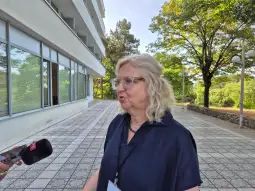
“The fact we have participants from foreign university centers who are actively working and researching issues related to Macedonian studies only confirm the distinctiveness of the Macedonian language,” Petrovska said.
Professor Victor Friedman, who participated in the first conference held in Michigan in June 1991, is also taking part in this year’s conference.
Speaking about the distinctiveness of the Macedonian language and identity, Friedman said all conferences focus on Macedonia as the heart of the Balkans with its “most interesting and still living linguistic processes”.
At a time of open denial of the distinctiveness of the Macedonian language, Professor Friedman said there should be no concern as long as children use their mother tongue – Macedonian – while they play.
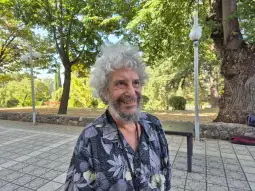
“The Macedonian language is alive and well. And even though many Greeks and Bulgarians pester me, we will endure,” Friedman said.
Professor Christina Kramer, who has been teaching Macedonian at the department of Slavic languages and literatures at the University of Toronto, highlighted the importance of such conferences for the promotion of the Macedonian language.
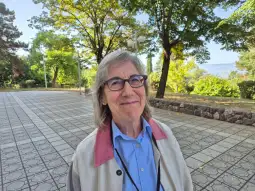
“It’s very important for those of us from other countries to gather, to be here together, to strengthen ourselves a bit because we know the conditions we always work under. We have to work for the Macedonian language, our research, what we teach, and at the same time we constantly have to explain why Macedonian, why we specifically study the Macedonian language,” Kramer said.
Since 1991 the conference has been held in the United States, Canada, and for the sixth time in Macedonia, Ohrid.
Photo: MIA


