Young people in EU leave parental home at 26.2, in North Macedonia at 32.1

Skopje, 25 September 2025 (MIA) - Young people in the European Union leave their parents’ house at an average age of 26.2 years. Generally young people in the north of the continent leave their parental homes at an earlier age than their peers in the southern part of Europe. Young people in Montenegro stay in their parents’ house the longest, moving out at an average age of 33.3, while the youth in Finland moves out at the earliest average age of 21.4. Macedonians on average continue to live with their parents until the age of 32.1.
The average age at which young people in the EU move out of their parental homes is slightly down from 2023 when it was 26.3. Since 2002, this average age has fluctuated mildly between a low of 26.1 years in 2019 and a high of 26.8 years in 2006.
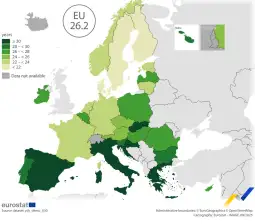
The highest average ages for leaving the parental home, at 30 years or above, were in Croatia (31.3 years), Slovakia (30.9), Greece (30.7), Italy (30.1) and Spain (30.0). In contrast, the lowest average ages were registered in Finland (21.4 years), Denmark (21.7) and Sweden (21.9).
The latest data for North Macedonia is from Eurostat's 2023 report, which showed young people in the country and in Montenegro stayed in their parents’ house the longest, moving out at 32.1 and 33.3 respectively.
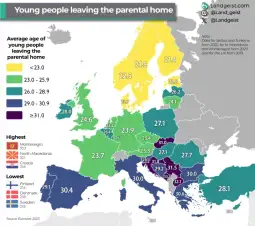
According to the analysis, more than half of people aged 20-25 in Southern Europe and the Balkans live with their parents, while in Northern Europe this percentage is below 20 percent, even below 10 in certain cases.
At a time when housing costs are under constant public debate, Eurostat data show that young people are somewhat more affected by housing costs. In 2024, 9.7% of young people (aged 15-29) in the EU lived in households that spent 40% or more of their disposable income on housing (housing cost overburden rate), while the same percentage for the total population was 8.2%.
In 2024, among EU countries, there were considerable differences in this rate. Greece (30.3%) and Denmark (28.9%) registered the highest housing cost overburden rates, far exceeding those in the Netherlands (15.3%), Germany (14.8%) and Sweden (13.5%). On the other hand, Croatia (2.1%), Cyprus (2.8%) and Slovenia (3.0%) had the lowest housing cost overburden rates.
In 16 EU countries, the housing cost overburden rate was higher among people aged 15-29 than for the population overall. The biggest difference between these 2 groups was 14.3 percentage points (pp) in Denmark, followed by the Netherlands with 8.4 pp.
Photo: MIA file photo/Eurostat/Landgeist


