Successful EU integration requires active engagement of civil society, unions, business community: conference

Skopje, 12 March 2026 (MIA) - In addition to reforms, a successful Euro-integration process also requires active participation of civil society, trade unions, organizations of employers and the business community, said speakers at a conference Thursday with social partners and civil society organizations from the country held by the European Economic and Social Committee (EESC) and its Western Balkans Follow-up Committee at Europe House Skopje.
The conference included discussions of the role of civil society in the accession talks, the state of social dialogue, as well as issues related to freedom of expression and fighting disinformation.
In his address, First Deputy Prime Minister and Minister of European Affairs Bekim Sali said European integration is not only a government process, but also a social project that requires active participation by civil society, trade unions, organizations of employers and the business community.
“Organized civil society should not be an observer, but a creator of reforms. The credibility of enlargement depends on real, measurable, and inclusive reforms,” Sali said.
He noted that effective social dialogue is a pillar of democratic maturity and a prerequisite for economic stability and European integration.
“The Government of the Republic of North Macedonia remains fully committed to the European path, the reforms, and the constructive dialogue with all stakeholders in society,” Sali said, adding that the Government remains committed to protecting civil society, media pluralism, and the fight against disinformation.
The Deputy Head of the EU Delegation in the country, Ben Nupnau, said North Macedonia’s accession to EU membership is a journey that involves not only institutions but also its citizens.
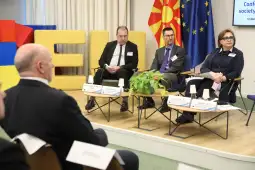
Nupnau stressed that the EU is strongly committed to protecting fundamental workers’ rights and aligning with international European standards, including key labor conventions and the European Social Charter.
“During the accession process, laws on labor relations, non-discrimination, occupational health and safety, and equal opportunities are of crucial importance. This demonstrates a commitment to fairness, dignity at work, and inclusive economic growth. We believe that economic growth goes hand in hand with social progress. Therefore, social dialogue is a cornerstone of Europe’s economic and social policies. Dialogue between the Government, employers, and workers on changes in the labor market and building trust between institutions and citizens is vital,” Nupnau said.
Violeta Jelić, head of the Western Balkans Follow-up Committee at the European Economic and Social Committee, said that the country’s civil society has had numerous opportunities to discuss and submit written opinions as part of certain discussions with their EU partners.
She noted that the Committee is the first European body that implements the principle of gradual accession of candidate countries in their daily work.
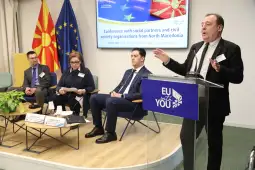
The head of the Fundamental Rights and Rule of Law Group within the European Economic and Social Committee, José Antonio Moreno Díaz, noted they have identified issues with the social dialogue in the country, i.e., with the real perception of consultations between social partners over the labor market and the state of the labor market, as well as weak implementation of workers’ rights, particularly in free trade zones, and discrimination of pregnant women on the labor market.
“Regarding discrimination, at meetings in Skopje I was told North Macedonia has a good legal framework, good institutional capacities, but that efficiency and the budget are lacking,” Moreno Díaz said.
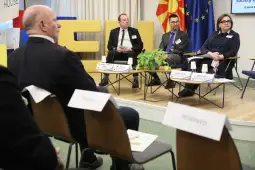 Branko Azeski, head of the Economic Chamber of North Macedonia, also spoke at the panel in his role as an associate member of the EESC. He underlined the business community’s position that the EU remains North Macedonia’s main trading partner, and that European integration is above all an economic and developmental necessity.
“For the business community, it is essential to have a clear, structured, and coherent dialogue throughout the accession process. By the end of this process, our companies must be fully prepared to face the market forces of the single market, maintain competitiveness, and contribute to European supply chains. This can only be achieved through our full involvement in the process,” Azeski stressed.
In its conclusions, the EESC reiterated that facilitating the integration of the Western Balkans into the EU remains a strategic priority, given their long-standing candidate status. The Committee firmly believes that a gradual, predictable, and merit-based approach, providing increased benefits during the accession process, is the best way forward for EU enlargement. It also noted that the socio-economic gap between EU partners and the Western Balkans remains a challenge, and that to achieve convergence, all partners must intensify reforms to seize the current momentum for enlargement and demonstrate the value of additional EU financial investment in the development of the region.
Photo: MIA


