Skopje observes 83rd anniversary of the deportation of Macedonian Jews

Skopje, 11 March 2026 (MIA) - We must not turn away from the past, and we must not shy away from the darkest chapters of history, instead we must acknowledge the horrific certainties, as well as the gaps, the uncertainties, and the questions that remain without clear answers to this day. We must not let the Macedonian Jews fade into oblivion. There can be many politically motivated narratives, but there is only one historical truth, said speakers at Wednesday’s observance of the 83rd anniversary of the deportation of 7.144 Macedonian Jews to the Treblinka death camp.
The President of the country’s Jewish Community, Pepo Levi, said at the event that even 83 years later the feeling remains the same, with bitterness and pain that will never pass.
Levi reminded that the Holocaust erased 98 percent of the country’s Jewish population, one of the highest percentages in all of occupied Europe.
“After the Second World War, in the 50s, 60s, 70s, no reasonable mind could have imagined that a time will come when someone would try to distort the history of the Holocaust. And yet today, eight decades after the end of the war, we are witnessing constant attempts to glorify the Nazis and their collaborators. Parallel narratives are being created, responsibility is being erased,” Levi said.
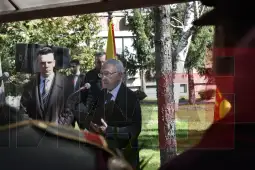
He underscored the importance of not letting the Macedonian Jews be forgotten.
“There can be many politically motivated narratives, but there is only one historical truth. In the memorial space of the Treblinka museum, where the ashes of thousands of people are mixed with soil and where stone markers bear the names of the countries from which the victims were brought, including the stone inscribed with ‘Macedonia’, today that stone is being disputed. There are demands for it to be renamed or removed because of political disputes, injecting daily politics into a mass grave. From here I want to make it absolutely clear: that stone is not a geopolitical formula, it is not a diplomatic position – it is the history of the Macedonian Jews. It is the history of Macedonia,” Levi stressed.
German Ambassador Petra Drexler stressed the importance of not turning away from the past and shying away from the darkest chapters of history.
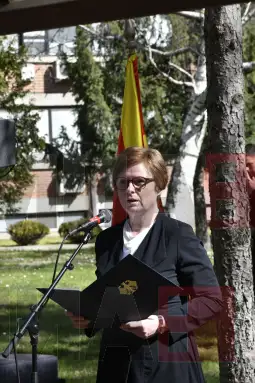
“Among the certainties is the historical responsibility of Nazi Germany for the crime against humanity that was the Holocaust. We acknowledge this responsibility, we accept our past knowing that the past cannot be overcome, because what has happened cannot be made undone. Accepting the past means acknowledging that we are all affected by its consequences. Accepting the past also means keeping the memory alive. To all those whose voices have been irrevocably silenced, we owe it to remember. We owe this remembrance also to ourselves, to protect us, as human beings, from our tendency to avert our gaze from inhumanity. And we owe our duty to remember to the descendants who will never forget,” the German Ambassador said.
In his address at the event, Prime Minister Hristijan Mickoski said remembrance is our moral duty, and the fight against hatred is our historical responsibility.
“In March 1943, more than seven thousand of our fellow citizens – Jews from Skopje, Bitola, and Shtip – were forcibly gathered, torn from their homes, from their families, from their lives. They were deported to the Treblinka death camp where their lives were brutally cut short. Behind that number there are names, families, dreams, talents, destinies. There are people who were a part of the tissue of our cities, of trade, of culture, of Macedonia’s spirit. With their disappearance, our country lost a piece of its soul,” Mickoski said.
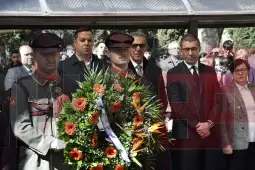
Prime Minister Mickoski stressed the anniversary reminds not only of the tragedy, but also of the duty to prevent hatred, antisemitism, racism, and intolerance in society.
“Today we are not reminded only of the tragedy, we are also reminded of our duty. The duty never to allow hatred, antisemitism, racism, and intolerance to find a place in our societies again. History teaches us that evil begins with a word, with prejudice, with indifference, and ends with tragedies that shake humanity. That’s why today, as a country and as a society, we renew our pledge: we will safeguard the truth, we will foster remembrance, and we will defend human dignity. Macedonia is a home of diversity. Our strength has always been in the fact that different cultures, religions, and traditions have lived together, creating a shared future,” Mickoski stressed.
The Prime Minister said the Jewish community has left an indelible mark on the history of the country, adding that its contribution to culture, education, business, and social life remains a part of the country’s shared heritage.
Jews from Bitola, Shtip, and Skopje were gathered in the Skopje Monopol building during the night between March 10 and 11, 1943, and from there, in three separate transports, they were deported to the Treblinka camp in occupied Poland.
The deportation of Jews from Macedonia began on March 22, 1943, and by March 29 of the same year, all Macedonian Jews had been sent to Treblinka – none of them ever returned.
In just 14 months, from August 1942 to September 1943, 925.000 people were murdered in Treblinka, among them the 7.144 Macedonian Jews.
Photo: MIA


