North Macedonia cannot influence external shocks, focus on strengthening domestic foundations for growth, World Bank's Paolucci tells MIA

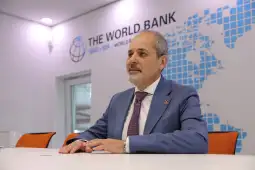
Skopje, 3 July 2025 (MIA) - While North Macedonia cannot influence external shocks such as geopolitical fragmentation or global commodity price fluctuations, it can focus instead on strengthening domestic foundations for growth. Stronger reform efforts, particularly on strengthening public financial management, human capital, governance, energy, and digitalization, which are aligned with commitments under the EU accession process, represent a foundational investment in the country’s long-term growth trajectory, says Massimiliano Paolucci, outgoing World Bank Group Country Manager for North Macedonia and Kosovo, in an interview with MIA.
Paolucci says prioritizing these reforms will be essential to sustaining growth and building a more resilient and competitive economy.
According to him, the country is no exception of the labor outflow trend, noting that limited access to quality job opportunities, as well as to good quality healthcare and education, and broader concerns about corruption and weak institutions significantly contribute to emigration decisions.
Paolucci says outmigration along with population aging is expected to significantly impact the pension system in North Macedonia, adding that the number of pensioners is to surpass the number of contributors by 2053, according to the World Bank 2024 Public Finance Report.
In the interview, available in full below, Paolucci provides an insight into the country's economy over the past five years of his term and the importance of the country's accession to the Single Euro Payments Area (SEPA).

Mr. Paolucci, you came to this country in 2020. From today's perspective, in your opinion, how much has the country managed to move forward economically in the past five years?
Since 2020, North Macedonia has been beset by a series of overlapping crises, but the country has shown notable economic resilience. Output exceeded pre-pandemic levels in 2022 and has continued to expand, while wages nearly doubled, unemployment fell to a new historic low, and inflation eased from the double-digit peak. Nevertheless, the economy’s growth rate is still below potential, held back by persistently low productivity and slow progress in human capital development. While fiscal prudence prior to the crises created space for a timely policy response, successive shocks have weakened fiscal outcomes and affected fiscal sustainability. Rebuilding fiscal buffers and restoring discipline is now essential to ensure fiscal policy remains supportive of growth and preventing adverse impacts of external shocks that are of higher frequency than ever.
You came at a time when North Macedonia and the world were facing one of the most severe health crises – Covid 19. As an international institution, you have played a significant role in dealing with the consequences of Covid-19. How much total financial resources were allocated to North Macedonia and what were they used for?
COVID19 is undoubtedly one of the most tragic health, social and economic crises that the world has faced over the past two centuries. Soon after the pandemic hit, the World Bank approved an emergency loan and tapped on contingency financing to save lives and livelihoods. We supported critical investments aimed at strengthening public health system’s response and resilience, co-financing a government wage subsidy scheme for around 22,000 SMEs and 155,000 private sector employees. In total, the World Bank made $143 million available to respond to the crisis.
What do we need to do as a country to get closer to the European average?
Similarly to other countries in the Western Balkans, with the average GDP per capita growth rate observed between 2010 and 2023, growing at current rates will not be sufficient to bridge the gap with the EU in terms of GDP per capita. Accelerating convergence will require ambitious and sustained reform efforts to improve connectivity in a context of increased regional integration, foster innovation, generate quality employment, enhance productivity, advance digitalization, and strengthen fiscal governance. These efforts are essential to raise the economy’s potential growth rate and move decisively toward EU income levels. However, reforms take time to generate long-lasting results. As such, they need to be sustained over time and across political cycles, thus avoiding policy reversals.
The World Bank's forecasts for North Macedonia for 2025 are that economic growth will be 2.6 percent, which is the lowest of the countries in the Western Balkans. What do you base this forecast on?
The World Bank prepares forecasts based on historical growth rates, high frequency indicators, EU trends, and expectations about future economic prospects. Over the past decade, North Macedonia’s growth has been on average lower than that of regional peers. Our Spring GDP growth projections for 2025 were at 2.6 percent, following the pronounced trade-policy uncertainty at the time—a risk that, although not yet materialized may negatively affect growth over the medium term. However, since then, the underlying conditions of growth seem to have improved. That means that, all things being equal and should no other crisis materialize over the coming months, we could expect GDP growth for 2025 to average 2.8%-3%. More details on that in our future publications.

There is geopolitical uncertainty, which certainly affects economic growth and increases in inflation. In such a situation, what should the country focus on?
While North Macedonia cannot influence external shocks such as geopolitical fragmentation or global commodity price fluctuations, it can focus instead on strengthening domestic foundations for growth. Stronger reform efforts, particularly on strengthening public financial management, human capital, governance, energy, and digitalization, which are aligned with commitments under the EU accession process, represent a foundational investment in the country’s long-term growth trajectory. In an environment of heightened uncertainty, prioritizing these reforms will be essential to sustaining growth and building a more resilient and competitive economy.
The trend of labor outflow does not bypass North Macedonia either. The average salary in the country is one of the lowest in the Western Balkans region. What is your recommendation?
Emigration is everywhere a complex and multifaceted phenomenon, driven by a combination of economic and institutional factors, and North Macedonia is no exception. Limited access to quality job opportunities, as well as to good quality healthcare and education, and broader concerns about corruption and weak institutions significantly contribute to emigration decisions, as confirmed by some indicators, such as the Balkan Barometer. Interestingly, while there is a widespread perception that wages in North Macedonia lag behind other countries in the region, the data published by national statistical institutes reveal something else—in the first quarter of 2025, the average reported gross monthly wage in North Macedonia was MKD 65,500 (approximately 1065 Euros), compared to 840 Euros in Albania and 639 Euros in Kosovo (for 2024, latest data available), while we are also cognizant of the large envelope wages that are not declared despite low personal income taxation.
The labor outflow also affects the stability of the pension fund. Are reforms needed in this area?
Indeed, outmigration along with population aging is expected to significantly impact the pension system in North Macedonia. Since 2017, there were already close to 68,000 people less in the labor force; the number of people that are working or actively looking for a job is on a continuous decline. And this trend is only expected to accelerate over the long run, with the population projections released by the State Statistical Office showing that the working age population (ages 15-64) is expected to nearly halve by 2070 and to be almost on par with the dependent population (ages below 15 and above 65). The number of pensioners is also expected to surpass the number of contributors by 2053 according to the World Bank 2024 Public Finance Report. Spending on pensions already reached 11.3 percent of GDP in 2024 while the first pillar pension fund is grappling with a deficit of 4 percent of GDP. A few years ago, North Macedonia undertook one of the most ambitious pension reforms in the region. But the challenges associated with ageing and migration require thorough consideration of alternatives to preserve its sustainability over time. Looking at the experience of other countries facing similar challenges, the reform options that North Macedonia could consider require broad stakeholder consensus and these include, among else, (i) indexing pensions with inflation to preserve pension purchasing power; (ii) gradually increasing pension contributions while boosting compliance and reducing the grey economy; (iii) gradually increasing the retirement age while introducing labor-market programs to upskill/reskill older adults that are able and willing to work; and alternative measures to boost investment returns.
The country has joined the Single Euro Payments Area (SEPA). How significant is this for North Macedonia?
Integrating North Macedonia into SEPA and modernizing payment systems is expected to generate substantial economic and financial inclusion benefits for Macedonian citizens and firms in the country. Currently, sending a 200 EUR remittance to North Macedonia costs around 15 EUR on average, with SEPA integration and the adoption of the fast payment system, this cost could fall to just 2 EUR. This reduction would save migrants and their families up to 20 EUR million annually. Additionally, financial inclusion remains relatively low in North Macedonia, with only 74 percent of adults using digital payments, which is below both regional and income-level peers. SEPA integration could also help expand access to financial services to an estimated 270,000 additional individuals, including 190,000 women. We are proud to be able to help the countries in the region with SEPA readiness. Montenegro is already bearing the fruits of that alignment.
You are leaving North Macedonia. What are your future plans, and which one is your next destination?
I am nearing the end of five rewarding years in this country. It's emotional to leave after working with great colleagues and partners from our counterparts, fellow development institutions and the World Bank team. I will bring many memories of citizens, civil servants, civil society and youth representatives, and entrepreneurs determined to turn the page on development and embrace a more sustainable, equitable and productive future for themselves and for the generations to come. I leave with indelible images of a country of breathless beauty where culture, traditions and passion blend with creativity, innovation and courage: this is what development is about. This is North Macedonia for me.
My next assignment is in Albania, right across the border. I will serve as the new World Bank Group Country Manager, representing the three agencies of our Group, namely IBRD, IFC and MIGA. My main objective is clear and exciting at once: blending public and private sector-oriented solutions to help meet Albania’s developmental priorities in the context of the EU accession process. Like Albania, North Macedonia’s future is with the EU. I am convinced that the World Bank will continue playing a key role in support of both countries’ journeys towards becoming EU members.
Biljana Anastasova-Kostikj
Photo: MIA


