Italy, Bulgaria and Malta join Belgium’s call for alternative options to aid Ukraine

Brussels, 13 December 2025 (MIA) - Italy, Bulgaria and Malta have joined Belgium’s calls to find alternative ways to secure €210 billion in financial support for Ukraine, instead of using frozen Russian assets, casting doubt on the adoption of the so-called ‘reparations loan’ plan at next week’s EU Summit.
According to Brussels media, the four countries are calling on “the EU Commission and Council to continue exploring and discussing alternative options in line with European and international law, with predictable parameters and significantly lower risks, in order to meet Ukraine’s financial needs through an EU credit line or transitional solutions, ensuring continuity of support before any of the proposed options effectively come into force.”
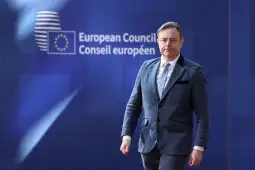
Belgian Prime Minister Bart De Wever has long called for alternatives to the reparations loan, which he has denounced as “fundamentally wrong” and claimed poses numerous legal and financial risks.
In a joint statement, the four countries supported the European Commission’s proposal to freeze Russian assets indefinitely, which was adopted at yesterday’s meeting of the Committee of Permanent Representatives of EU member states (COREPER), but emphasized that this does not imply support for using these funds to “support Ukraine’s military efforts.”
The decision was made based on Article 122 of the Treaty on the Functioning of the EU, which provides that in “emergency” situations, decisions are taken by qualified majority rather than by consensus. Accordingly, the adoption of the decision required the support of at least 15 Member States representing at least 65% of the EU population.
Belgium and Hungary opposed using Article 122 to adopt the decision, stating that doing so could put the EU at risk of breaching European law.
“This article applies to an emergency within the EU. Where is the emergency? There is an emergency in Ukraine. But Ukraine is not part of the European Union,” De Wever said.
In the statement, Italy, Bulgaria, Malta and Belgium warned that the use of Article 122 “implies legal, financial, procedural, and institutional consequences that might go well beyond this specific case” and that Friday’s decision should not “constitute precedent” for the bloc’s security and foreign policy, which typically requires unanimity.
Regarding the decision to freeze Russian assets indefinitely, the EU Council announced that the member states, through an urgent procedure, adopted a measure “temporarily prohibiting any transfer to Russia of the assets of the Russian Central Bank currently frozen in the EU,” in order “to limit damage to the Union’s economy.”
“Concretely, the regulation agreed prohibits, on a temporary basis, any direct or indirect transfer of assets or reserves of the Central Bank of Russia, or of any legal person, entity or body acting on behalf of, or at the direction of, the Central Bank of Russia, such as the Russian National Wealth Fund,” the EU Council said.
According to the EU Council, in the absence of such a prohibition, any additional resources would be directly used by Russia to finance its war of aggression against Ukraine with serious consequences for the economy of the European Union and its member states.
“It would exacerbate the risk of an escalation of hybrid belligerent activities targeted against the member states and in the territory of the EU, thereby deepening economic difficulties in the Union. It would also risk prolonging and aggravating economic uncertainty and require a greater fiscal response from the member states,” reads the press release.
Previously, the freezing of Russian sovereign assets was decided every six months by consensus of the EU member states, which caused concern that a member could block further extensions of the measure.
This decision is also seen as a step forward toward reaching an agreement to approve the plan to use frozen Russian assets to provide the so-called reparations loan for Ukraine. Permanently freezing the Russian assets would ensure that these funds are not returned to Russia, even if sanctions in the country are lifted.
This aligns with Belgium’s position, which is seeking guarantees that it will not bear the risks alone if it becomes necessary to return these used funds to Russia.

Belgium opposes the “reparations loan” because the largest portion of frozen Russian assets in the EU, around €185 billion, is held at the clearing house Euroclear, based in Brussels. Consequently, Belgium fears that using the frozen Russian assets could damage its reputation as a secure depository and lead to the withdrawal of deposited foreign funds, and it also raises concerns about the legality of such a procedure.
At yesterday’s COREPER meeting, Belgium submitted a document requesting “independent and autonomous” guarantees from the other EU member states in exchange for its consent to use frozen Russian assets to fund the so-called “reparations loan” for Ukraine, stating that these guarantees would remain in effect “even if the loan is deemed void.”
Belgium is also demanding the adoption of measures to protect it from potential retaliation by Moscow, as well as commitments from EU member states not to enter into new investment agreements with Russia.
Among Belgium’s other requests is that the remaining EU members participate in covering any legal costs in the event that Moscow initiates proceedings against any country in the bloc.
Regarding Euroclear, Belgium is requesting that the clearing house “not be held responsible” for providing the reparations loan, and that its directors “bear liability only in cases of gross negligence.”
The matter has become more pressing after the Central Bank of Russia announced that it is suing Euroclear in a Moscow court, alleging that the Brussels clearing house is guilty of “actions that prevent the Bank from freely accessing its own funds and securities.” The Russian Central Bank further argues that all EU efforts, direct or indirect, to use the frozen Russian assets are “completely illegal” and violate international law by infringing on the “sovereign immunity of state assets.”
According to reports, COREPER is set to hold an extraordinary meeting Sunday to discuss the Belgian document’s demands and seek an agreement on the reparations loan ahead of the EU Foreign Affairs and General Affairs Council sessions on Monday and Tuesday, and before the EU Summit on Thursday.
Photo: MIA archive


