Aleksandar Turundzhev executed in front of his two children and wife, symbol of betrayal as our curse

Skopje, 31 August 2025 (MIA) - The personal tragedy of the Macedonian revolutionary Aleksandar Turundzhev, betrayed by a compatriot for 150 gold coins and hanged by the Turkish authorities at Bitola's At Pazar on Aug. 30, 1905, besides being a symbol of what often permeates Macedonian history, betrayal, is much more a symbol of the hational hero and the Macedonian people's fight for freedom. Turundzhev was executed in front of numerous witnesses, including his wife and their two minor children, a daughter and a son, who were forced to silently watch their father's last breath.
He was a Macedonian revolutionary. A member of the Macedonian Revolutionary Organization. A Lerin rebel leader. He had great courage and determination in the battles with the Turkish army, which at times, as historians say, turned into madness. The Turkish government knew these qualities of his and always feared his actions. He protected Macedonian people from abusers, robbers, oppressors, and he dealt most cruelly with Greek and Andardian bands. Besides fighting against the Ottoman authorities, Turundzhev was a great fighter against Greek, Serbian and Bulgarian propaganda in Macedonia, especially after the Ilinden Uprising.
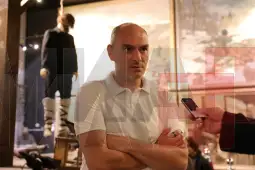
"He was born in the village of Ekshi Su, Lerin (Gorno Vrbeni) Ottoman Empire, today the Republic of Greece. He joined the ranks of the Secret Macedonian-Odrin Revolutionary Organization (TMORO) at a very young age, first as a rebel band member, and later as a leader. Before the organization was formed, he was a hajduk, and after joining TMORO he was a member of the revolutionary committee in Constantinople, and then acted as a terrorist group member. In 1902, he was a rebel band member under the leadership of Georgi Papanchev and acted in Lerin. In 1903, he was appointed rebel leader in Lerin," Ilija Vasileski, historian guide at the National Museum of the Macedonian Struggle for Independence in Skopje, told MIA.
Turundzhev, Vasileski said, was an active participant in the Ilinden Uprising of 1903 in the Lerin region and under the leadership of the rebel band leaders Mihail Chekov and Georgi Pop Hristov participated in a large number of battles against the Ottoman army.
Historian Gjorgi Chekutkov from Bitola told MIA that in the past he tried to research Turundzhev's legacy a little more. He said he was a Macedonian revolutionary who lived to be only 33, and 16 of his years he had dedicated to the Macedonian liberation cause. He believes that there is little known historiographical data or published research papers about him, despite his greatness as a revolutionary who not only fought the Turkish army but also led an unwavering fight against Greek propaganda, as well as Serbian and Bulgarian propaganda, especially after the Ilinden Uprising.
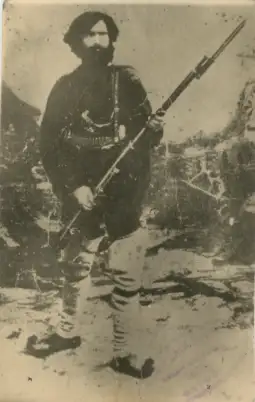
He protected the Macedonian population from the attacks of the Turkish oppressors. He was involved in the very first stages of organizing the revolutionary network. He was one of the most prominent revolutionaries in the Bitola district. Turundzhev tirelessly traveled through the villages of Kostur, Bitola, Lerin, and all the way to Mala Prespa, conducting training and purchasing ammunition, forming the Macedonian revolutionary network in this region. He was very brave and determined in battles against the Turkish army, which at times turned into madness. The Turkish authorities knew these qualities of his and always feared his actions. He protected Macedonian people from the abusers, robbers and oppressors, and he dealt most cruelly with the Greek and the Andardi bands, Chekutkov said.
According to him, in the whirlwind of the Ilinden Uprising he showed a fanatical, self-sacrificing fight. He participated in the attacks on the railway station in Lerin and in Gorno Vrbeni he carried out sabotage actions.
After the tragic end of the uprising, he remained in the interior of enslaved Macedonia. Although an amnesty was declared for the komitas who would give up further fighting, he, Chekutkov said, did not lay down his arms. On the contrary, with the rebel leader Damjan Gruev, he worked on reviving the Bitola revolutionary district. After the failed uprising, he remained in his native district and helped restore the revolutionary network in the Bitola revolutionary district. He was elected a member of the Lerin Mountain Chieftaincy.
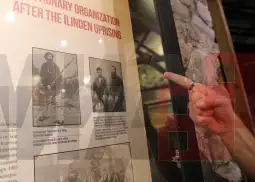
After the Ilinden Uprising was suppressed, the situation in Ilinden Macedonia, and especially in the Bitola revolutionary district, became very difficult. The measures taken by the Ottoman rulers, the increased presence of armed groups from neighboring countries, but also Vrhovist factions, which were primarily aimed at paralyzing the activities of the organization, caused enormous damage to the revolutionary movement. This period of the Macedonian national liberation movement was also marked by intensified persecution and fierce clashes with the Ottoman military, in which prominent rebel leaders of the organization such as Hristo Uzunov, Nikola Karev, Gjorgji Sugarev, Dame Gruev, Pando Kljashev and others lost their lives. This further contributed to the deterioration of the situation and the deepening of the organizational crisis.
After the failure of the Ilinden Uprising, Turundzhev's fate changed in 1904, when he was betrayed by the spy Mitre Ginkov in the village of Ajtos. The Ottoman authorities arrested him and took him to the investigative prison in Bitola. There he was subjected to brutal torture and held for over a year. While imprisoned, he attempted to commit suicide by jumping from the prison window, but failed, according to the Encyclopedia VMRO 1893-1934, edited by Nikola Zhezov.
After a long detention, he was sentenced to death by the Ottoman court in Bitola. The punishment was a public execution - hanging in At Pazar in Bitola on Aug. 30, 1905. His tomb is in Bitola's St. Sunday church.
"At the Museum of the Macedonian Struggle, visitors have the opportunity to see one of the most moving scenes from Macedonian revolutionary history - the hanging of the Lerin rebel leader Aleksandar Turundzhev at Bitola's At Pazar, a tragic event that resonated strongly with the public at the beginning of the 20th century. The wax figure, made with exceptional precision, captures the fateful moment of the execution, carried out by the Ottoman authorities on Aug. 30, 1905. The hanging was carried out publicly, as an act of intimidation, in front of numerous witnesses, including his wife and their two minor children, a daughter and a son, who were forced to silently watch their father take his last breath," historian Vasileski said.
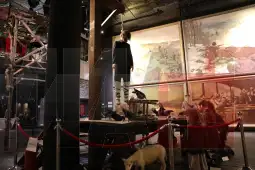
He added that the museum has reconstructed the scene at the then At Pazar in Bitola, with historical details, clothing and architectural elements.
"The exhibit is not only a testimony to the personal tragedy of Aleksandar Turundhzev but also a symbol of the Macedonian people's perseverance, sacrifice and unstoppable fight for freedom. This part of the museum exhibit leaves a deep impression on visitors, encouraging empathy, reflection and a deeper understanding of Macedonian history," Vasileski said.
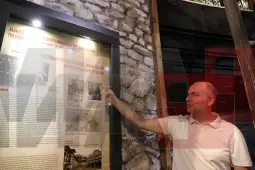
Turundzhev's execution, immortalized in the museum exhibition, was the result of the betrayal by Mitre Ginkov, who, according to information, betrayed him for 150 gold coins.
The historian Chekutkov from Bitola said the Greek authorities had sent the Greek-born Mitre Ginkov to befriend Turundzhev and offer him his house as a shelter.
"While Turundzhev was sleeping, Ginkata betrayed him for 150 gold coins. The vile friend led the pursuit of some 10-15 soldiers, carefully opened the door and the soldiers pounced on the sleeping rebel leader. So he could not even defend himself and he was not given the opportunity to sacrifice himself, either - that is, to take his own life so he would not fall alive into the hands of the soldiers," Chekutkov said.
In his brochure "Macedonian Patriot" dedicated to Turundzhev, he said he conveyed the long-standing testimony of his fellow komitadji called Kokoncheto, who said that the rebel leader had given him an order to fire if they heard the thunder of his rifle, but they did not hear anything so they did not go to save him.
"After his arrest, his one-year prison martyrdom began. He was sent to the Lerin prison and subjected to severe torture. The next day, he was exposed to the Lerin square in order to scare the Macedonian population that their protector had been captured. He was sent on foot to Bitola with a cordon of Turkish soldiers. Along the way, he was terribly tortured, beaten, and not given a sip of water. He fell unconscious several times. In Bitola, they threw him into the Chingel Karakol prison, where the torture continued, and he jumped out of the window to take his own life. But he did not die, he only broke his legs. They moved him to a more secure prison, Kataline, and began the judicial investigation against him. Turundzhev was thrown into the narrow spaces of the dark and damp Bitola dungeons, in which a person could neither turn around nor sit nor lie down. They tortured him a lot, put spikes under his nails, burned him with a hot iron so that he would reveal his collaborators in the city. His answer was only, 'I know Bitola, I don't know anyone in Bitola'," Chekutkov quoted parts of the brochure.
According to him, there are also quotes from the dialogue that took place between Turundzhev and the Turkish judicial authorities.
"Tell me, Alekso, why didn't you surrender in time when the Sultan granted amnesty?" they asked him. "Because I want to kill the Sultan and replace the Turkish fez caps with hats," Alekso replied.
Turundzhev was sentenced to death by public hanging at At Pazar on Aug. 29 (Aug. 19 in the old style), 1905, and was executed on Aug. 30.
"Turundzhev's execution was deliberately done in public, to scare the population. With shackles and chains on his hands and feet, he was first exhibited at the square in Bitola. The procession started from the Clock Tower near Bezisten, the Dragor River and all the way to At Pazar. Turundzhev was placed on a horse-drawn cart, and a hearse walked in front, reading the news that he would be executed. Over 3,000 Bitola residents joined the procession, most of them in tears. As the procession passed them by, Christians closed up their shops and followed the rebel leader. The crowd stopped at At Pazar. A gallows was erected on the square! There was a cordon of Turkish guards. A little to the side, a dervish began to read the verdict. Next to him, a confused priest asked him about his last words. 'Turundzha?' He climbed onto a basket, grabbed the rope, proudly raised his eyes to the sky and shouted: 'Macedonia will be free!' Even in the last moments of his execution, he did not want to be hanged by the Turkish authorities, but climbed onto the gallows himself, put the rope around his neck and after his shout, hanged himself, Chekutkov wrote in the brochure.
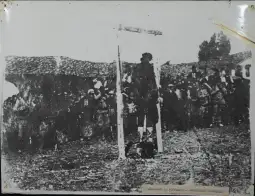
In the archival photo of the hanging of Turundzhev, it can be seen that a cordon of armed soldiers stood between the citizens and the rebel leader.
"That same afternoon, several thousand citizens followed the coffin, which was covered with wreaths, to St. Sunday church where the body was buried in a tomb right behind the altar. His son Blagoj was left an orphan at the age of one and a half and never remembered the face of his father," Chekutkov said.
Out of grief, the people sang the song "Aleksandro Turundzhev Had a Tragic Fate", which remains remembered and sung word for word to this day.
In Bitola, at the Veterinary Center near At Pazar, at the place where the Macedonian rebel leader Turundzhev lost his life 120 years ago, a memorial was raised to mark 120 years since his death.
Slavica Stefanovska
Photo Frosina Naskovic
Museum of the Macedonian Struggle for Independence in Skopje


