From Sept. 8, 1991 until now: 35 years of Macedonian independence

Skopje, 8 September 2026 (MIA) – Three and a half decades ago, the citizens of Macedonia declared the country a sovereign and independent state in the historic Sept. 8, 1991, referendum. This 35th anniversary of Macedonian independence marks one of the most turbulent and significant eras in the nation's modern history.
From the referendum "Yes" under the slogan "I'm voting for Macedonia", through the peaceful independence and the uphill battle for international recognition, to the country's admission to the United Nations, the 2001 conflict, the Ohrid Framework Agreement, the name dispute, the Prespa Agreement and NATO membership — the Macedonian path has been paved with historical upheavals, political crises, difficult compromises and a perpetual struggle for stability and international affirmation.
Sept. 8, Independence Day, is one of the most important dates in modern Macedonian history – the day when citizens, amid the disintegration of the former Yugoslav federation, democratically chose independence as the country's path forward.

From historical roots to modern statehood
The Macedonian statehood idea did not originate with the 1991 vote. It was based on decades of aspirations for national and political affirmation, the traditions of the Ilinden Uprising and the Krushevo Republic of 1903, as well as the decisions of the ASNOM Anti-fascist Assembly for the National Liberation of Macedonia's first session.
On Aug. 2, 1944, at the Prohor Pchinski Monastery, the first ASNOM session was held, laying the foundations of the modern Macedonian state.
After World War II, Macedonia became one of the federal units within the then Yugoslavia. The next few decades saw the development of state institutions, the codification of the Macedonian language and the establishemnt of national cultural and scientific organizations.
The collapse of Yugoslavia in the late 1980s and early 1990s, however, started a new chapter in history – the question of full state independence.

Democratic changes and the road to the referendum
The early 1990s brought major political changes across Eastern and Southeastern Europe. The fall of communist regimes and the introduction of multi-party political systems created a new political reality. The political and economic upheavals of the late 1980s prompted the accelerated development of Macedonia's democracy and economy. The League of Communists, until then the only party in power, was joined by newly formed political parties.
The first multi-party parliamentary elections in Macedonia were held in 1990, which ushered in political pluralism and the political system's democratic transformation. The republic elected its first government, led by Nikola Kljusev. According to the Declaration of Sovereignty of the Socialist Republic of Macedonia, adopted on Jan. 25, 1991, the government's main goal was the Constitution of Macedonia as an independent state.
During this government's term, the 1991 Macedonian independence referendum was held. Voters were asked, "Are you in favor of a sovereign and independent state of Macedonia, with the right to enter a future union of the sovereign states of Yugoslavia?" Following the vote, the Republic of Macedonia adopted its new Constitution and established its monetary independence.

At that time, the Yugoslav federation was in a deep political crisis. Differing visions for Yugoslavia's future and growing national and political opposition pushed several republics to declare their independence.
It was in these circumstances that the Macedonian state leadership and institutions began the republic's process leading to its own declaration of independence.
Sept. 8, 1991: "I Vote for Macedonia"
The independence referendum, which remains one of the most important democratic events in the history of the Macedonian state, was held on Sept. 8, 1991. The vote was preceded by a Declaration of Sovereignty, which was adopted by the first multi-party Macedonian parliament on Jan. 25, 1991.
Citizens in the referendum answered the question:
"Are you in favor of a sovereign and independent state of Macedonia, with the right to enter a future union of the sovereign states of Yugoslavia?"
Under the slogan "I vote for Macedonia," citizens turned out in high numbers to decisively back the country's independence.

According to the official results, more than 95 percent of those who voted were in favor of a sovereign and independent Macedonia.
Out of 1,495,807 voters, 71.85% or 1,132,981 citizens turned out. Of those who voted, 95.26% or 1,079,308 citizens voted in favor (or 72.16% of the total number of citizens with the right to vote).
As an expression of the democratic will of the majority of citizens, the referendum provided political legitimacy for the further process of independence.
On the evening of Sept. 8, 1991, a celebration was held at Skopje's central square to mark the referendum's successful outcome. The first president of independent Macedonia, Kiro Gligorov, the first prime minister, Nikola Kljusev, and the first parliament speaker, Stojan Andov, delivered short speeches at the celebration.
Kiro Gligorov addressed the citizens from the stage in the square with the words, "Dear citizens of Macedonia, allow me tonight to congratulate you and all citizens of Macedonia on a free, sovereign and independent Macedonia!"
That message remained as a symbol of the moment in history when Macedonia confirmed its commitment to an independent state.
The Declaration of Independence and the First Constitution
Formally, the people's will for a sovereign and independent state was confirmed with a Declaration of Acceptance of the Referendum Results on Sept. 18, 1991, in the Republic of Macedonia's Parliament.

Just two months later, on Nov. 17, 1991, the Constitution of the Republic of Macedonia was adopted, laying the foundations of the new political and legal system.
The Constitution defined Macedonia as a sovereign, independent, democratic and social state, and established the basic principles of parliamentary democracy, the separation of powers and the protection of human rights and freedoms.
Peaceful independence in a troubled region
The Macedonian path to independence was specific in one important way – independence was achieved without a war.
In a time when Yugoslavia's collapse was marked by wars across Slovenia, Croatia, Bosnia and Herzegovina, Macedonia avoided the scenario of an immediate armed conflict.

The Yugoslav People's Army withdrew from the territory of Macedonia in 1992 peacefully. Not only did the troops take away all weapons but they also tore out electrical outlets from the barracks.
On Feb. 21, 1992, an agreement was reached and signed in Skopje for the dislocation, or withdrawal, of the Yugoslav People's Army from the territory of the Republic of Macedonia. The agreement was signed by President Kiro Gligorov and Colonel General Blagoje Adžić, Chief of the General Staff.
The withdrawal took place peacefully and without armed clashes, which was notable at a time when other parts of former Yugoslavia were already experiencing military conflicts. Almost all heavy weapons, artillery, tanks, aircraft and other military equipment were withdrawn, leaving military facilities damaged or empty.
The last member of the Yugoslav People's Army left Macedonia on March 27, 1992, completing the process of the country's military independence.
With the departure of the Yugoslav People's Army, border crossings and military facilities were taken over by the newly formed Armed Forces of the Republic of Macedonia and the police.
This event is one of the key moments in the process of independence, as Macedonia became the only former Yugoslav republic the JNA departed from without military conflict.
But peaceful independence did not mean an easy start. The new state faced immediate economic hardship amid the collapse of the former Yugoslav common market, regional sanctions and complex challenges in establishing its own monetary, economic and security infrastructure.
The battle for international recognition
One of the new state's greatest challenges was securing international recognition.
After the failed Conference for a Peaceful Resolution of the Crisis in Yugoslavia, a Declaration on the Dissolution of Yugoslavia was adopted on Dec. 16, 1991, calling on the Yugoslav republics to declare whether they wanted to become independent and internationally recognized states.
Macedonia, along with three of the six former Yugoslav republics — Slovenia, Croatia, and Bosnia and Herzegovina — backed the Declaration. However, the European Community recognized Slovenia and Croatia in January 1992, even though the specially formed Badinter Commission had approved only Macedonia and Slovenia as meeting the requirements for independence. In addition, the European Community conditioned the country's recognition on omitting the word Macedonia from its name.
At that time, on Jan. 15, 1992, Bulgaria and Turkey were the first countries to recognize Macedonia's statehood. Recognitions followed from Slovenia, Croatia, Bosnia and Herzegovina as well as many other countries.

The dispute with Greece over the name Macedonia became a serious obstacle in the country's international integration process.
Despite this, on April 8, 1993, by acclamation in the General Assembly of the United Nations, Macedonia was admitted as the 181st full member of the World Organization. However, due to the opposition and pressure of Greece, which did not accept the country's constitutional name, the UN membership UN was made with the temporary designation Former Yugoslav Republic of Macedonia.
In the following years, the state established diplomatic relations with numerous countries, gradually boosting its international standing.
In 1995, the Interim Agreement with Greece was signed, after Greece had previously imposed a blockade on the country.
Transition, economic challenges and political maturation
The first years of independence were also marked by a complex process of transition from a socialist to a market economic system.
Privatization and a rising jobless rate created severe economic hardship in the 1990s.The restructuring of state enterprises and the collapse of fraudulent investment schemes, such as the TAT savings house in Bitola, triggered widespread financial loss. Unemployment spiked from 190,000 in December 1992 to 330,000 by 1998.
At the same time, the state was developing the institutions required for an independent political and economic system.

In 1992, the Macedonian denar was introduced as the national currency, and the year also saw the establishment of the modern state's institutions: the diplomatic service, the army, the central bank and other key structures.
The process of democratic consolidation, however, was not without its problems. In the following decades, Macedonia faced political crises, sharp divisions between political parties, accusations of corruption, and challenges to the rule of law.
2001 – the biggest security challenge
Ten years after independence, Macedonia faced the most serious security crisis in its recent history.
In 2001, an armed conflict broke out between security forces and armed groups of ethnic Albanians.
The conflict threatened the state's stability and raised serious questions about interethnic relations.
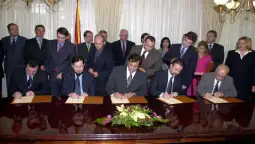
With the mediation of the international community, the Ohrid Framework Agreement was signed in August 2001.
The agreement resulted in a political framework for ending the conflict and introducing reforms into the system aimed at advancing the rights of communities and ensuring greater representation of ethnic communities in institutions.
The European path: Candidate status and years of waiting
European integration has been one of the state's strategic goals since its first years of independence.
In 2005, Macedonia received candidate status for membership in the European Union.
Despite the European Commission's recommendations to start negotiations, however, the process was blocked for years due to the name dispute with Greece.
After resolving the dispute with Greece, in 2020, the EU made a political decision for opening accession negotiations with Macedonia, under its now official name of North Macedonia.
The process, however, continued to be accompanied by new bilateral issues and conditions. This time it was Bulgaria putting conditions on the country's accession, based on the 2017 Good Neighborhood Agreement.
Despite long-standing obstacles, EU membership remains one of the central strategic commitments of the Macedonian state.

The Prespa Agreement and new name
The Prespa Agreement was signed in 2018, and with its coming into effect, despite the failed referendum of Sept. 30, 2018, the country changed its constitutional name to the Republic of North Macedonia.
On March 27, 2020, North Macedonia officially became the 30th member of NATO.
Three and a half decades later
In its 35 years of independence, Macedonia has gone through a process that many other countries have been building for many more decades. Over these 35 years, the country dealt with issues directly affecting its identity, name, international recognition, security and European perspective.
From a former federal unit in Yugoslavia, the country built its own institutions, its own army, diplomatic network, monetary system and international legal subjectivity.
Regardless of political rifts and different opinions on decisions made in the past decades, Sept. 8, 1991, remains the pivotal point in the independent Macedonian state's modern history.


